

CUBITUS VARUS
Cubitus varus refers to a medical condition that affects the elbow joint. It appears as a type of deformity in which the forearm bones are angled inward. This causes the elbow to point outward in a “V” shape. A congenital abnormality or a traumatic injury to the elbow, such as a fracture, can cause the deformity. Cubitus varus can lead to difficulty in performing everyday tasks. For instance, carrying objects can also result in pain and weakness in the affected arm.
At the Medical City Children’s Orthopedics and Spine Specialists medical practice, our expert Cubitus Varus doctors and surgeons are dedicated to diagnosing and treating children with all types of medical conditions to ensure comprehensive care is tailored to each patient’s needs. We only specialize in children’s health, and we have undergone advanced training to do so. We treat minor and very major medical conditions with a compassionate approach, and our team cares for patients suffering from Cubitus Varus.
If your child needs surgery or casting, our Fracture Care Clinic opens every day and you do not need an appointment. Surgery rooms get scheduled every morning, so your child receives the care and attention they need right away.
Cubitus Varus
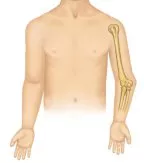 Doctors sometimes refer to Cubitus Varus as the gunstock deformity. It is the most common complication of a broken arm bone (right above the elbow) in children. The deformity includes improper bone formation in the sagittal plane and internal rotation deformity in the axial plane. It also includes the loss of coronal alignment, which causes the distal forearm and hand to deviate from the midline of the body. The body handles the deformity well and corrects movement problems through shoulder motions. Neither of these abnormalities might require repair, but surgeons usually repair the coronal plane deformity. In the majority of instances, malunion appears as the cause of the deformity. Additionally, the following may cause Cubitus Varus as well.
- Type I impacted or comminuted supracondylar fractures.
- Fractures of type II that appear rotationally unstable and become cast-treated with a subsequent loss of reduction
- Type III ignored or poorly fixed fractures.
Surgeons Can Fix These Deformities
A youngster with cubitus Varus often has an ugly deformity and a good range of motion (ROM) at the elbow. Even though some research claims that the functional arc is preserved despite an uneven flexion arc and a restriction of elbow flexion range on the afflicted side. According to other writers, the malformation has no functional effects.
Studies have revealed, however, that long-term follow-up of kids with cubitus varus might lead to issues including a higher risk of lateral condyle fractures or other secondary fractures, posterolateral elbow discomfort and instability, and delayed ulnar nerve palsy. Furthermore, the clinical importance of several studies of elbow joint morphology and alignment changes in cubitus varus continues. Even though patients are frequently asymptomatic, and the patient ignores the deformity, the aforementioned consequences, as well as aesthetic issues, usually necessitate surgical intervention. However, even though doctors believe that surgery works well to correct this deformity, therapy works well in some cases, too.
QUESTIONS AND ANSWERS
What constitutes Cubitus Varus in children, and what causes it?
Cubitus varus refers to a condition characterized by an abnormal inward angulation of the forearm at the elbow, causing the arm to deviate towards the body. In children, this condition occurs as a result of a supracondylar humerus fracture, which is a common childhood elbow injury. When the fracture heals improperly, it can lead to a deformity in the alignment of the forearm bones, resulting in cubitus varus.
What are the common symptoms and signs of cubitus varus in children?
Children with cubitus varus may have visibly angled forearms at the elbow, often referred to as “gunstock deformity.” Other symptoms may include limited range of motion in the affected elbow, difficulty fully extending the arm, and potential discomfort or pain in the elbow region. The severity of the deformity and associated symptoms can vary based on the extent of the condition.
How do doctors diagnose Cubitus Varus
Diagnosis involves a physical examination and imaging studies, such as X-rays, to assess the degree of deformity and confirm the diagnosis. Treatment options depend on the severity of the cubitus varus. In mild cases, doctors will just observe and monitor the patient. Especially if the child does not experience significant functional limitations or pain. Doctors may recommend physical therapy to improve range of motion and strength. In more severe cases where the deformity affects function or causes discomfort, doctors may recommend surgery to realign the bones and correct the deformity.
When it comes to children and their medical conditions, parents need to think of the very best — Medical city Children’s Orthopedics and Spine Specialists.
Symptoms of Cubitus Varus
Cubitus varus varies depending on the severity of the deformity and any associated problems. Therefore, the primary and secondary symptoms include:
Visible Deformity
- Doctors see the most notable feature of cubitus varus as an inward angulation of the elbow. Instead of the normal carrying angle (valgus angulation), the forearm deviates toward the body’s midline when extended.
- This creates a “gunstock” appearance, which appears most noticeable when the arms are held at the sides with the palms facing forward.
Reduced Carrying Angle
- Normally, the carrying angle (valgus angle) of the elbow is 10-15 degrees in females and 5-10 degrees in males.
- In cubitus varus, this angle is reversed or reduced, causing medial deviation of the forearm.
Limited Range of Motion (ROM)
- Although many patients retain near-normal elbow function, some experience restricted motion, particularly in extension and supination.
- Stiffness may develop over time, especially if the deformity progresses.
Functional Impairment
- Some individuals may experience difficulty with certain activities that require full elbow extension or forearm rotation, such as throwing or lifting objects.
- Weakness in grip strength may occur due to altered muscle alignment.
Pain and Discomfort (Occasional Symptom)
- In mild cases, pain normally does not occur. However, pain may occur in moderate to severe deformities:
- Chronic elbow pain due to altered joint mechanics.
- Soft tissue irritation from abnormal bone alignment.
- Increased fatigue or discomfort after prolonged activities involving the affected arm.
Instability and Secondary Complications
- Over time, untreated cubitus varus can lead to instability of the elbow joint and increased stress on adjacent structures.
- Some patients may develop posterolateral rotatory instability (PLRI), in which the elbow becomes prone to recurrent dislocations or subluxations.
Ulnar Nerve Symptoms (In Severe Cases)
- In progressive or severe cubitus varus, the abnormal alignment may place pressure on the ulnar nerve, leading to:
- Tingling or numbness in the ring and little fingers.
- Weakness in hand muscles, particularly affecting grip strength.
- Elbow pain that radiates down the forearm along the ulnar nerve distribution.
Diagnosis of Cubitus Varus
Diagnosing cubitus varus requires a combination of clinical examination and imaging studies to assess the severity of the deformity and its functional impact.
Medical History
- The physician will take a detailed history, focusing on:
- Previous elbow injuries, particularly supracondylar fractures during childhood.
- Onset and progression of deformity.
- Symptoms of pain, weakness, or nerve involvement.
Physical Examination
A. Visual Assessment
- The patient is asked to stand with arms extended at their sides (anatomical position).
- The clinician observes for:
- Carrying angle reduction or reversal (medial deviation of the forearm).
- Gunstock deformity of the elbow.
B. Range of Motion (ROM) Testing
- The examiner evaluates elbow flexion, extension, supination, and pronation to detect any motion limitations or asymmetry.
- Comparison with the unaffected limb is crucial.
C. Neurological Examination
- If ulnar nerve compression is suspected, tests include:
- Tinel’s sign: Tapping over the ulnar nerve at the elbow to check for tingling sensations in the fingers.
- Grip strength assessment: Testing for weakness in the affected hand.
D. Stability Testing
- Varus and valgus stress tests are performed to assess ligament integrity and check for elbow instability.
Imaging Studies
A. X-rays (Radiographs) – Standard Evaluation
- Anteroposterior (AP) and lateral views of the elbow are obtained to:
- Measure the humerus-elbow-wrist angle and confirm varus alignment.
- Detect malunion or bone irregularities at the distal humerus.
- Assess joint congruency and rule out degenerative changes.
B. Carrying Angle Measurement
- The normal carrying angle (valgus angle) is measured on an X-ray.
- A reversed or reduced angle confirms cubitus varus deformity.
C. 3D CT Scan (Advanced Cases)
- Used for preoperative planning in severe cases requiring surgical correction.
- Provides detailed visualization of bone alignment and joint abnormalities.
D. MRI (If Soft Tissue or Nerve Involvement is Suspected)
- Indicated when ulnar nerve compression or ligamentous injury is a concern.
- Helps assess nerve entrapment and soft tissue damage.
Conclusion
Cubitus varus is primarily diagnosed based on clinical examination and radiographic analysis. While mild cases may not cause functional issues, moderate to severe deformities can lead to pain, restricted movement, or nerve compression, necessitating further evaluation and potential surgical intervention. In conclusion, early diagnosis is key to preventing complications and optimizing patient outcomes.
When to do the Surgery?
Our surgeons believe that the body should heal before a corrective surgery occurs, and about a year covers that healing. Consequently, our surgeons consider the patient’s needs, their physical condition when determining a planned procedure.
Surgical Approach
There are three surgical techniques: medial, lateral, and posterior. The lateral technique appears as the most popular since it offers good exposure with minimal dissection. Surgeons believe that the correction of complex osteotomies requires a posterior approach that offers a larger amount of exposure.
Which Deformities Need Correction?
A tri-planar malformation called cubitus varus consists of varus, hyperextension, and internal rotation. The defects that need correction continue as the subject of intense discussion. Also, some experts advise correcting hyperextension in children older than 10 years old since the possibility of remodeling decreases after that age. In younger children, the hyperextension deformity will reconstruct with time. Authors who favor tri-planar osteotomy to address all three abnormalities have argued for rotational correction.
Others, however, have questioned the need for such intricate techniques and stated that rotational abnormalities don’t even require correction. The ultimate option will rely on the surgeon’s preferences and experience. At Medical City Children’s Orthopedics and Spine Specialists, we think that in the majority of instances, lateral closed wedge osteotomies to treat varus in the sagittal plane produce successful outcomes. Older children may also benefit from hyperextension correction.
The Fixation Techniques to Keep the Osteotomy Stable
Surgeons consider many different stabilization techniques. Such as a cast above the elbow, K-wires, a single or double cortical screw, screws with tension wire loops, plates, and external fixators. According to doctors’ reports, threaded wires or Steinmann pins work better than smooth K-wires since they purportedly back out with the loss of fixation. For younger children with smaller bones and postoperative cast support, surgeons will use wires and screws.
With a reconstructive plate or a one-third tubular plate, surgeons stabilize osteotomies in older kids. This will provide a firmer fixation with fewer risks of fixation loss. This may allow for early mobilization depending on fixation stability, which is advocated by some. However, doing so necessitates that the distal fragment accommodate at least two wires. Furthermore, this procedure becomes problematic for young children’s cooperation and pin tract care.
Depending on the size of the bones, smaller children may benefit from K-wires, whereas older children may need plate fixation. French reported using screws with wire loop fixation, although this approach has a significant risk of fixation loss. It has been successful in employing reconstruction plates with little danger of fixation loss. In order for the osteotomy to function well with the least amount of danger of fixation loss, we at Medical City Kids Ortho suggest a reconstruction plate fixation.
What Issues Might Cubitus Varus Correction Cause?
Correcting cubitus varus can involve a surgical procedure to realign the bones of the forearm and reposition the elbow joint. While the goal of the procedure is to improve function and reduce pain, there are potential risks and complications associated with any surgery, including:
- Pain: Although the surgery is performed to relieve pain, some patients may experience temporary or persistent pain after the procedure.
- Stiffness: A loss of motion in the affected arm, which could make it difficult to perform certain activities, such as reaching overhead.
- Nerve and blood vessel injury: There is a risk of nerve and blood vessel damage during surgery, which could lead to weakness, numbness, or other symptoms.
- Infection: As with any surgical procedure, there is a risk of infection.
- Implant failure: If metal implants are used during the procedure, there is a risk that they could loosen, break, or cause other complications.
It’s important to keep in mind that these risks and complications may vary from patient to patient. Our surgeon will discuss the potential benefits and risks of the procedure with each patient before proceeding with surgery. Additionally, Doctors will institute precautions during the surgical procedure to minimize the risk of any complications.
Our Management Protocol
Medical City Kids Ortho recommends surgical treatment for all cubitus varus abnormalities. However, the child and parents must make the final choice after a thorough discussion of the benefits and drawbacks. At Medical City Kids Orthopedics and Spine Specialists, we choose lateral closed wedge oblique equal limb osteotomies. Surgeons consider the angles of the break and strategies to bring the very best outcomes when planning an osteotomy before surgery. The osteotomy is closed, and the wedge is removed intraoperatively. The carrying angle is examined together with limb alignment. The osteotomy is prolonged to attain >5° of carrying angle if the limb is still in varus. Surgeons use reconstruction plates with three or four holes for fixation.
Rehabilitation
To avoid problems, including another fracture, lateral instability, and nerve palsies, doctors and surgeons believe that surgery is the best outcome for a cubitus varus deformity. Surgeons correct the condition by conducting a lateral closed wedge osteotomy. Surgeons reduce problems by using the proper fixation, ideally with a plate and screw. The look and placement of the scar, as well as the post-correction lateral bump, constitute two factors that might influence the outcome of the repair, and surgeons take these into account when making a choice.
Why Choose Medical City Children’s Orthopedics and Spine Specialists
Orthopedics is a specialty of our doctors and surgeons at Medical City Children’s Orthopedics and Spine Specialists. Furthermore, they understand your concerns and can answer your questions regarding your child’s condition. Their excellence allows them to use their specialized knowledge and training to find a medical solution. Doctors Richard Hostin, MD, Shyam Kishan, MD, and Kathryn Wiesman, MD, specialize in children and are considered to be the very best by many children’s doctors.
The very first reason to choose Medical City Children’s Orthopedics and Spine Specialists for your child is that we are experts in children’s health. Also, there is sometimes a small difference between different elbow injuries. Parents want their child treated for the exact cause, and we can deliver that treatment. We do it all the time in our Arlington, Dallas, Flower Mound, Frisco, and McKinney, TX offices. To obtain the very best care and treatment, we invite parents to give us a call to make an appointment for their child for any pain coming from their child’s elbows.
____________________
Citation: National Library of Medicine – Cubitus Varus
The medical content on this page has been carefully reviewed and approved for accuracy by the Medical City Children’s Orthopedics and Spine Specialists qualified healthcare professionals, including our board-certified physicians and Physician Assistants. Our team ensures that all information reflects the latest evidence-based practices and meets rigorous standards of medical accuracy, with oversight from our expert spine doctors to guarantee reliability for our patients.
Call 214-556-0590 to make an appointment.
Comprehensive services for children from birth through adolescence at five convenient locations: Arlington, Dallas, Flower Mound, Frisco and McKinney.