
Pediatric Spine Disorders in Children
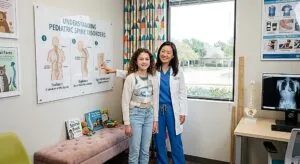 Pediatric spine disorders affect the developing spinal column in infants, children, and adolescents. These conditions range from mild curves that doctors monitor closely to complex deformities that require advanced treatment. Early recognition leads to better outcomes because children’s spines grow rapidly. At Medical City Children’s Orthopedics and Spine Specialists, our pediatric-only team diagnoses and treats these disorders every day. We focus exclusively on children, so we understand how growth, development, and age influence each condition. Below we describe the most frequent pediatric spine disorders, their causes, symptoms, diagnosis, and modern treatment options.
Scoliosis – The Most Common Pediatric Spine Disorder
Scoliosis tops the list of spine disorders in children. Doctors define it as a sideways curve of the spine that measures 10 degrees or more on an X-ray. Idiopathic scoliosis accounts for roughly 80 percent of cases and has no known single cause, though genetics often plays a role. It appears most often in adolescents but also occurs in juveniles (ages 4–10) and infants. Congenital scoliosis develops when vertebrae form incorrectly before birth. Neuromuscular scoliosis arises in children who have cerebral palsy, muscular dystrophy, or other conditions that weaken muscles supporting the spine. Syndromic scoliosis links to genetic syndromes such as Marfan syndrome, neurofibromatosis, or Ehlers-Danlos syndrome.
Parents and pediatricians notice scoliosis through uneven shoulders, a prominent rib hump when the child bends forward, or an off-center waistline. Many children feel no pain in early stages. Specialists confirm the diagnosis with standing X-rays and measure the curve using the Cobb angle. They also assess skeletal maturity to predict progression. Treatment depends on curve size and the child’s age. Doctors observe mild curves (under 20–25 degrees) with regular X-rays. They prescribe custom braces for moderate curves in growing children. For severe or rapidly progressing curves, surgeons use growth-friendly techniques such as MAGEC rods or vertebral body tethering, or they perform spinal fusion when the child nears skeletal maturity. Our team tailors every plan to the child’s specific type of scoliosis and overall health.
Kyphosis (Roundback or Hunchback)
Kyphosis causes an exaggerated forward curve in the upper or mid-back. Scheuermann’s kyphosis, the most common form in adolescents, occurs when vertebrae wedge together during growth. Postural kyphosis appears when children slouch and usually improves with posture training and core strengthening. Congenital kyphosis results from malformed vertebrae present at birth. Children with kyphosis often show a rounded upper back, shoulder rounding, or back pain after prolonged sitting or activity. Doctors diagnose it with lateral X-rays and measure the kyphotic angle. Mild cases respond well to physical therapy and bracing. Severe or painful curves may require surgery to straighten the spine and prevent long-term complications such as breathing difficulty or nerve compression.
Hyperlordosis (Swayback)
Hyperlordosis exaggerates the inward curve in the lower back. It often appears in children with tight hip flexors, weak abdominal muscles, or certain neuromuscular conditions. Obesity, poor posture, or compensatory changes from scoliosis or hip disorders can also trigger it. Parents notice a pronounced sway in the lower back, protruding abdomen, or difficulty standing straight. Doctors evaluate hyperlordosis with physical exams and X-rays. Most children improve dramatically with targeted physical therapy that strengthens the core and stretches tight muscles. In rare persistent cases linked to underlying spine or hip problems, surgeons address the root cause to restore normal alignment.
Spondylolysis and Spondylolisthesis
Spondylolysis is a stress fracture in the pars interarticularis, a small bony bridge in the back of the vertebra. It occurs most often in the lower lumbar spine of active children who participate in sports that involve repetitive back extension, such as gymnastics, football, or dance. When the fracture allows one vertebra to slip forward on the one below it, doctors call the condition spondylolisthesis. Children complain of low back pain that worsens with activity and improves with rest. Some develop hamstring tightness or leg pain if nerves become irritated. Specialists confirm the diagnosis with X-rays, CT scans, or MRI. Most cases heal with rest, bracing, and physical therapy focused on core stability. Surgeons intervene only when slippage is severe or pain persists despite conservative care.
Tethered Cord Syndrome and Spinal Dysraphism
Tethered cord syndrome occurs when the spinal cord attaches abnormally to surrounding tissue and cannot move freely as the child grows. It often accompanies spinal dysraphism (incomplete closure of the spinal column during fetal development), such as spina bifida occulta or lipomyelomeningocele. Symptoms include leg weakness, foot deformities, bladder or bowel control problems, or back pain. Doctors diagnose it with MRI and sometimes urodynamic studies. Early surgical release of the tether prevents permanent nerve damage. Our neurosurgical and orthopedic teams work together to correct the tether and stabilize the spine when needed.
Congenital Vertebral Malformations
Some children are born with hemivertebrae (half-formed vertebrae), fused vertebrae, or other malformations that cause congenital scoliosis or kyphosis. These anomalies create unbalanced growth and progressive curves. Parents may notice asymmetry at birth or during the first few years. Specialists use detailed X-rays and 3D CT imaging to map the exact malformation. Treatment ranges from observation for very mild cases to early surgery (such as hemivertebra resection and fusion) for rapidly progressing curves. Early intervention often prevents severe deformity and the need for more extensive surgery later.
Infections, Tumors, and Trauma
Spinal infections (discitis or osteomyelitis) and tumors remain uncommon but require urgent attention. Children with discitis often refuse to walk or bend, develop fever, or show back tenderness. Tumors may cause night pain, weakness, or scoliosis as the body compensates. Traumatic fractures or dislocations from falls or sports injuries can also produce spinal deformity if not treated promptly. Doctors rely on MRI, CT, and blood tests for rapid diagnosis. Treatment usually combines antibiotics for infection, surgical removal or stabilization for tumors, and careful bracing or surgery for fractures. Our team coordinates with infectious disease specialists and oncologists to deliver comprehensive care.
Why Early Detection Matters
Pediatricians and school screenings play a vital role in catching spine disorders before they cause major problems. When doctors identify a disorder early, they can often manage it with observation, bracing, or physical therapy instead of surgery. Early treatment also protects lung function, posture, balance, and self-confidence. Parents who notice uneven shoulders, a rib hump, limping, or back pain should schedule an evaluation promptly. At Medical City Children’s Orthopedics and Spine Specialists, we offer same-day fracture care and rapid appointments for suspected spine disorders.
Expert Care at Medical City Children’s Orthopedics and Spine Specialists
Our surgeons treat only children and adolescents. They bring deep pediatric expertise, extensive experience with complex cases, and active leadership in scoliosis research. Families throughout North Texas choose our five convenient locations in Dallas, Arlington, Frisco, Flower Mound, and McKinney because they know their child receives care from a team that understands growing spines. We combine the latest diagnostic tools, growth-friendly surgical techniques, and compassionate support to help every child achieve the healthiest spine possible.
If you have concerns about your child’s spine or posture, contact us today. Early evaluation gives your child the best chance for successful treatment and an active childhood. Call (214) 556-0590 or visit medicalcitykidsortho.com to schedule an appointment.
____________________
Citation: Proper Swaddling – International Hip Dysplasia Institute
The medical content on this page has been carefully reviewed and approved for accuracy by the Medical City Children’s Orthopedics and Spine Specialists’ qualified healthcare professionals, including our board-certified physicians and Physician Assistants. Our team ensures that all information reflects the latest evidence-based practices and meets rigorous standards of medical accuracy, with oversight from our expert spine doctors to guarantee reliability for our patients.

Recent Comments