
Limping in Children – Causes, Evaluation, and When to See a Specialist:
Parents often notice a change in the way their child walks. A limp means the child walks differently from the normal pattern for their age. Most limps come from minor issues that resolve quickly, yet some signal conditions that need prompt evaluation by a pediatric orthopedic specialist. At Medical City Children’s Orthopedics and Spine Specialists, our board-certified, fellowship-trained surgeons focus exclusively on children and adolescents. We diagnose and treat the full range of causes of limping so your child can return to comfortable, normal activity.
What Is a Limp in a Child?
A limp occurs when a child alters the normal sequence of walking steps. The most common pattern is an antalgic gait—the child shortens the time spent standing on the painful leg to reduce discomfort. Younger children may not clearly describe pain, so parents often first notice a preference for one leg, a waddle, or reluctance to walk or run. Understanding the likely causes by age helps families and doctors identify the problem faster.
Common Causes of Limping in Children by Age Group
Causes of limping change with a child’s age and stage of growth. The lists below highlight the conditions we see most often.
Toddlers and young children (approximately 1–3 years)
- Toddler’s fracture – a subtle spiral break in the tibia that can follow a minor twist or fall; the child may still try to walk.
- Transient synovitis (also called toxic synovitis) – temporary inflammation of the hip joint that often follows a recent viral illness.
- Developmental dysplasia of the hip – when the hip joint has not formed properly and has gone unrecognized.
- Infection – septic arthritis or osteomyelitis can produce sudden refusal to bear weight and fever.
- Soft-tissue injury, a foreign body in the foot, or, less commonly, non-accidental trauma.
School-age children (approximately 4–10 years)
- Transient synovitis remains the most frequent non-traumatic cause.
- Legg-Calvé-Perthes disease – interruption of blood supply to the femoral head that can produce a progressive limp and hip or knee pain.
- Trauma or overuse injuries from active play and sports.
- Juvenile idiopathic arthritis or other inflammatory conditions.
- Infection (septic arthritis or osteomyelitis).
- Rarely, tumors or discitis.
Adolescents (approximately 11–16 years and older)
- Slipped capital femoral epiphysis (SCFE) – the ball of the hip slips off the neck of the femur through the growth plate; stable SCFE allows walking while unstable SCFE does not.
- Overuse conditions such as Osgood-Schlatter disease, Sever’s disease, stress fractures, or osteochondritis dissecans.
- Acute trauma from sports or falls.
- Inflammatory or rheumatologic conditions.
- Rare bone tumors.
Causes that can appear at any age
Trauma (fractures, sprains, contusions), infection, transient synovitis, leg-length difference, neuromuscular conditions, and, infrequently, tumors or malignancy.
Many of these conditions already have detailed pages on our website. We encourage you to explore the specific information on transient synovitis, Perthes disease, and slipped capital femoral epiphysis.
Red Flags – When a Limp Needs Immediate Attention
Contact a doctor promptly or seek emergency care if your child shows any of these signs:
- Fever, looking ill, or refusing to put any weight on the leg.
- Pain that wakes the child at night or steadily worsens.
- Systemic symptoms such as unexplained weight loss, night sweats, or loss of appetite.
- Sudden inability to walk after minor or no clear trauma (especially in toddlers).
- Rapid progression of the limp over hours or a few days.
- Any concern that the limp could stem from infection or an unstable hip condition such as SCFE.
Early evaluation protects growing joints and improves long-term outcomes.
How We Evaluate a Limping Child
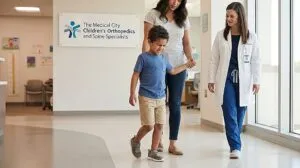 Our pediatric orthopedic specialists begin with a careful history. We ask about the onset of the limp, any recent illness or trauma, pain location, activity level, and family history. Next we observe the child’s gait and perform a complete physical examination that includes range of motion of the hips, knees, and ankles, limb-length measurement, and a check of the spine and abdomen.
Imaging usually starts with plain X-rays. When we suspect fluid in the hip joint, we order an ultrasound. Magnetic resonance imaging (MRI) or other studies follow if the diagnosis remains unclear. Laboratory tests (complete blood count, sedimentation rate, and C-reactive protein) help distinguish infection or inflammation from less urgent causes. This systematic approach allows us to rule out serious conditions quickly and arrive at an accurate diagnosis.
Treatment Overview
Treatment depends entirely on the underlying cause. Many minor injuries and transient synovitis improve with rest, activity modification, and anti-inflammatory medication. Infections require urgent antibiotics and sometimes surgical drainage. SCFE almost always needs surgical stabilization. Perthes disease may involve observation, bracing, or surgery depending on the child’s age and the stage of the disease. Fractures receive appropriate immobilization or fixation.
Because children’s bones and growth plates respond differently from adult tissues, specialized pediatric orthopedic care makes a meaningful difference. Our team designs each treatment plan around the individual child’s age, activity goals, and specific diagnosis.
Why Families Choose Medical City Children’s Orthopedics and Spine Specialists
We treat only children and adolescents. Our surgeons—Richard A. Hostin, MD, Shyam Kishan, MD, and Kathryn Wiesman, MD—are board-certified and fellowship-trained in pediatric orthopedics. Families trust us for both common and complex causes of limping because we combine deep experience with modern diagnostic tools and a child-friendly environment.
We welcome patients at five convenient locations across the Dallas–Fort Worth area:
- Dallas
- Arlington
- Flower Mound
- Frisco
- McKinney
Questions to Ask at Your Visit
- What is the most likely cause of my child’s limp?
- Does my child need any tests or imaging today?
- Should my child avoid weight-bearing or certain activities right now?
- When should we schedule the next follow-up?
- What warning signs mean we should call or return sooner?
Take the Next Step
A persistent or painful limp deserves expert evaluation. Call us today at 214-556-0590 to schedule an appointment with one of our pediatric orthopedic specialists. You can also use our patient portal or ask your referring physician to send records. Early attention helps most children return quickly to the activities they enjoy.
The medical content on this page has been carefully reviewed by the board-certified physicians and physician assistants at Medical City Children’s Orthopedics and Spine Specialists. We update information regularly so families receive accurate, evidence-based guidance. This material is for educational purposes only and does not replace personalized medical advice.
Expert Care for Limping Children at Medical City Children’s Orthopedics and Spine Specialists
Our team has extensive experience evaluating and treating orthopedic conditions in children, We work closely with pediatricians, and physical therapists to provide coordinated care.
Call (214) 556-0590 to schedule an appointment or for questions about your newborn’s orthopedic evaluation.
Our Locations
- Dallas – 7777 Forest Lane, Building C, Suite 135, Dallas, TX 75230
- Frisco – 5575 Frisco Square Blvd., Suite 240, Frisco, TX 75034
- McKinney – 4510 Medical Center Drive, Suite 301, McKinney, TX 75069
- Arlington – 515 W. Mayfield Road, Pavilion 1, Suite 301, Arlington, TX 76014
- Flower Mound – 4300 Windsor Centre Trail, Suite 400, Flower Mound, TX 75028
____________________
Citation: American Family Physician – The Limping Child
The medical content on this page has been carefully reviewed and approved for accuracy by the Southwest Scoliosis and Spine Institute’s qualified healthcare professionals, including our board-certified physicians and Physician Assistants. Our team ensures that all information reflects the latest evidence-based practices and meets rigorous standards of medical accuracy, with oversight from our expert spine doctors to guarantee reliability for our patients.

Recent Comments